

Sue Pats
Why Compromise Always Costs More Than You Think
Why Compromise Always Costs More Than You Think
Bhagavad Gita 1.36-37 - The Fundamental Truth: Why Compromise Always Costs More Than You Think
"Even Though They May Be Aggressors, Sin Will Certainly Come Upon Us If We Slay Them. How Can We Hope to Be Happy by Killing Our Own Kinsmen?"
We've reached the deepest insight in Arjuna's crisis.
Not just moral objection. Not just practical concern.
But existential truth:
You cannot be happy while compromising yourself.
The Progression to Deepest Understanding
Let's trace Arjuna's journey to this point:
Stage 1: Physical Collapse (Verses 28-31) "I can't do this. My body is failing."
→ The body knows first.
Stage 2: Meaninglessness (Verses 32-33) "Even if I could, what would be the point?"
→ The mind questions the goal.
Stage 3: Moral Resolve (Verses 34-35) "I will not do this. Period."
→ The will commits to values.
Stage 4: The Deepest Truth (Verses 36-37) "I cannot be happy while doing this."
→ The soul recognizes the cost.
Each stage goes deeper than the last.
The deepest understanding isn't intellectual. It's existential.
It's not: "This is wrong." (That's moral.)
It's: "This is wrong FOR ME. And I cannot be at peace while doing it."
The Core Question: Can You Be Happy While Compromising?
Arjuna is asking the fundamental question:
"How can we hope to be happy by killing our own kinsmen?"
This question assumes something crucial:
You cannot achieve genuine happiness while violating your deepest values.
Not temporary happiness (achievement, success, money).
But real happiness (peace, integrity, contentment).
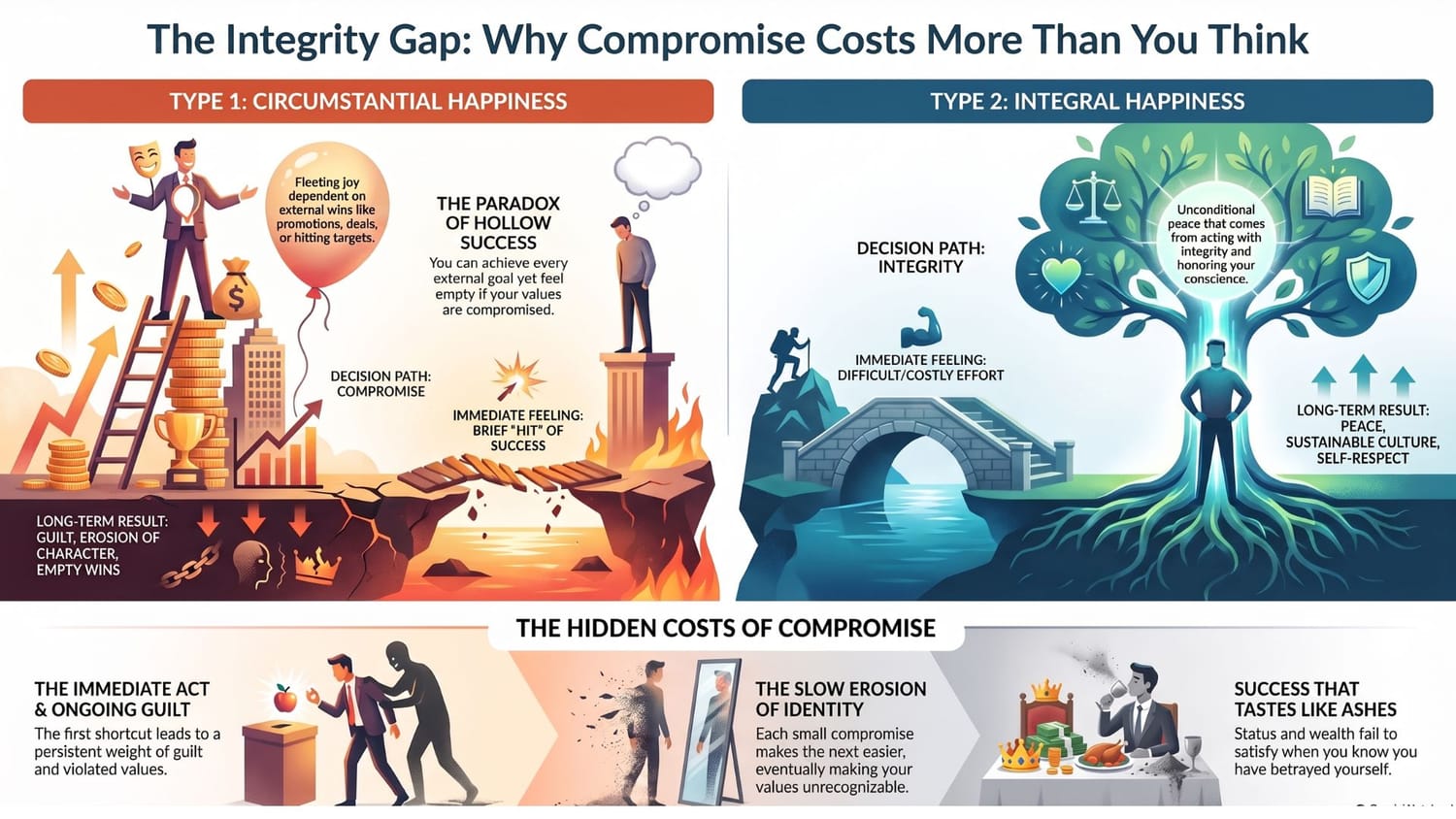
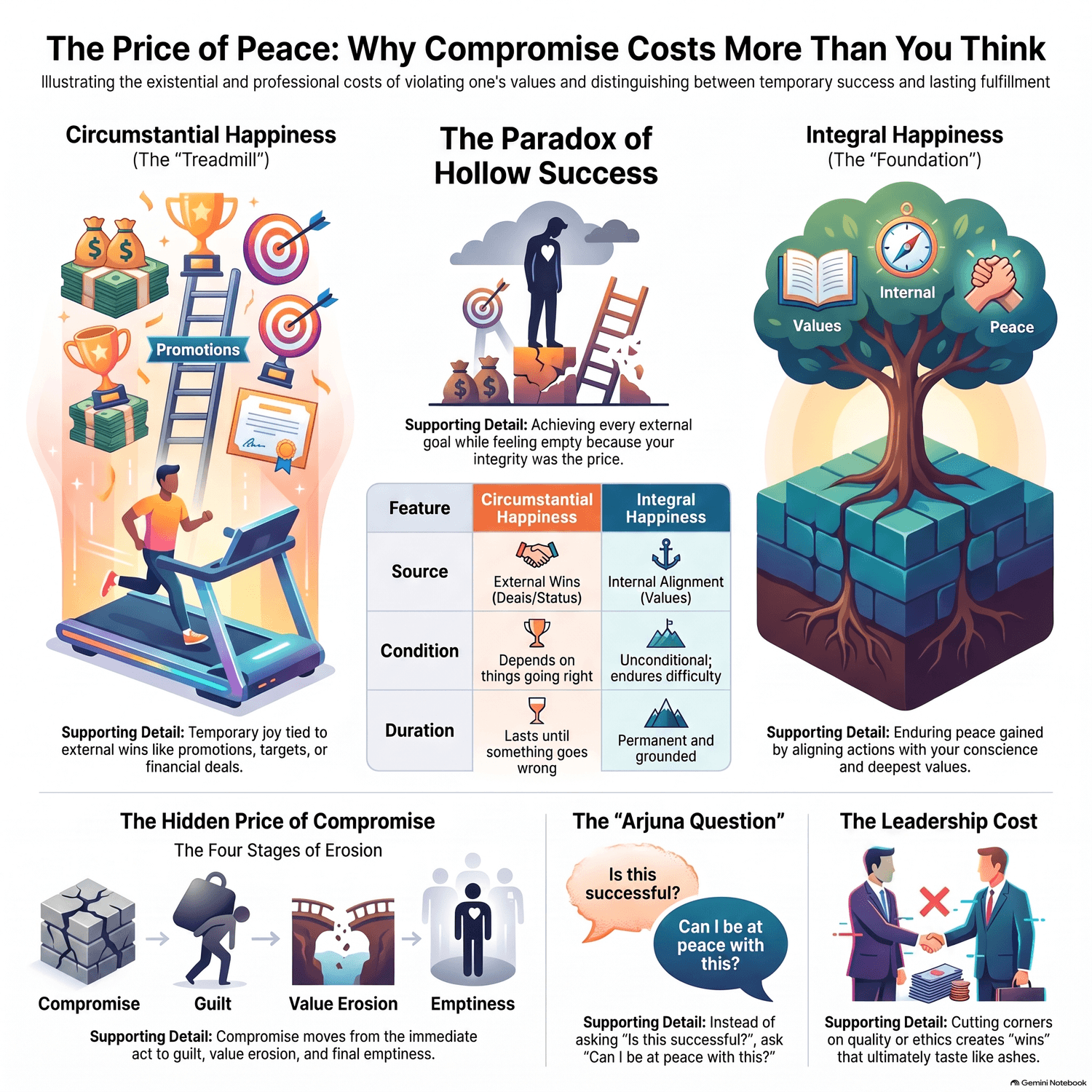
The Two Types of Happiness
There are two different types of happiness:
Type 1: Circumstantial Happiness
Definition: Happiness that depends on external circumstances.
Examples:
Getting the promotion (happy)
Winning the deal (happy)
Hitting the target (happy)
Making the money (happy)
Characteristic: It's conditional. It depends on things going right.
Duration: It lasts until something goes wrong.
Cost: You're constantly chasing the next circumstance that makes you happy.
Type 2: Integral Happiness
Definition: Happiness that comes from being aligned with your values.
Examples:
Acting with integrity (content)
Keeping your word (peaceful)
Honoring relationships (grounded)
Living according to your conscience (at ease)
Characteristic: It's unconditional. It doesn't depend on outcomes.
Duration: It endures through difficulty.
Cost: It requires staying true to yourself, even when it's costly.
Arjuna is recognizing that you can have Type 1 (circumstantial) without Type 2 (integral).
And if you do, you're not actually happy. You're just distracted.
Why Compromise Always Costs More Than You Think
When you compromise your values, you pay a price:
The Immediate Cost: The Act
You do the thing you said you wouldn't do.
You lie, cheat, cut corners, hurt people, whatever.
The cost is visible: you did it.
The Ongoing Cost: The Guilt
Every day after, you carry guilt.
You remember what you did. What you violated. Who you hurt.
The guilt is there whether you acknowledge it or not.
The Slow Cost: The Erosion
Each compromise makes the next one easier.
Your values get weaker. Your integrity erodes. You become someone you don't recognize.
The Hidden Cost: The Unhappiness
You can't be fully happy because part of you knows you're compromised.
You have success, but it tastes like ashes.
You have money, but it doesn't satisfy.
You have status, but you feel empty.
This is what Arjuna is recognizing.
Even if he wins, even if he gets the kingdom, even if he achieves victory—he'll carry the cost of compromising his values.
And that cost is bigger than the gain.
The Business Equivalent: The Cost of Compromise
The Founder Who Compromises Quality
Decision: "We'll cut corners on quality to hit the timeline."
Circumstantial happiness: The product launches on time. (Happiness Type 1)
The ongoing cost:
You know it's not your best work
Customers discover the shortcuts
Your reputation takes a hit
You carry regret
The "victory" feels hollow
Result: You have success but not happiness. (Missing Type 2)
The Executive Who Compromises Ethics
Decision: "We'll manipulate the numbers to hit the targets."
Circumstantial happiness: You hit the targets. You get the bonus. (Happiness Type 1)
The ongoing cost:
You know it's dishonest
You're afraid of getting caught
You've betrayed your integrity
You can't look people in the eye
You carry shame
Result: You have achievement but not peace. (Missing Type 2)
The Leader Who Compromises People
Decision: "We'll push the team to burnout to hit the metrics."
Circumstantial happiness: You hit the metrics. You get recognition. (Happiness Type 1)
The ongoing cost:
Your best people leave
Culture becomes toxic
You know you hurt people
Team trust evaporates
You carry guilt
Result: You have wins but not a sustainable culture. (Missing Type 2)
The Paradox: More Success, Less Happiness
Here's the paradox Arjuna is recognizing:
The more you compromise your values to succeed, the less happy you are.
Not because success is bad. But because compromised success is hollow.
You can have everything and still feel empty.
You can achieve everything and still feel lost.
You can win and still feel like you've lost.
Why People Stay on the Compromise Path
If compromise makes you unhappy, why do people keep compromising?
Reason 1: They Don't Connect the Dots
They don't realize the unhappiness comes from the compromise.
They tell themselves: "I'm just busy. I'm stressed. This is normal."
They don't see the connection between the compromises and the emptiness.
Reason 2: They're Addicted to Circumstantial Happiness
Once you get a hit of circumstantial happiness (the promotion, the deal, the success), you want more.
So you keep compromising to get more.
It's a treadmill, but you're addicted to the hits.
Reason 3: They Think It's Temporary
"Once I make it, I'll stop compromising."
"Once I hit this goal, I'll slow down."
"Once I'm successful enough, I'll live by my values again."
But by then, the compromises have become habit. And you don't know how to live any other way.
Reason 4: They Don't Know There's Another Way
They think: "If I don't compromise, I won't succeed."
"Everyone compromises. It's just how business works."
"Nice guys finish last."
So they keep compromising because they don't see an alternative.
The Path to Real Happiness
What Arjuna is discovering is that there's another path:
Success with integrity.
Not success despite values. But success aligned with values.
This path is:
Slower (you can't cut corners)
Harder (you have to find creative solutions)
Less profitable short-term (integrity often costs more)
But it leads to real happiness:
Peace with yourself
Sustainable culture
Trust from others
Sleep well at night
Pride in what you've built
The Practice: Testing Your Happiness
If you want to know whether you're compromising yourself, practice this:
Practice 1: Check Your Baseline Happiness
Without any wins or achievements happening, how happy are you?
Not "busy-happy" from hitting targets.
But baseline content: Do you feel at peace?
If not, you might be compromising.
Practice 2: Notice the Gaps
After a "win," do you feel genuinely happy?
Or do you feel a brief hit of excitement followed by emptiness?
If it's the latter, the win might be compromised.
Practice 3: Listen to Your Conscience
Your conscience knows. It's always telling you.
Are you ignoring it? Talking over it? Rationalizing against it?
If so, you're compromising.
Practice 4: Ask the Arjuna Question
"Can I be truly happy with this decision?"
Not "Is this successful?" But "Can I be at peace with this?"
If the answer is "no," you're heading toward compromise.
The Deepest Teaching
What Arjuna is discovering is this fundamental truth:
Integrity is not a luxury add-on to success.
It's a requirement for peace.
You can have success without it. But you can't have happiness.
This Week's Reflection
For yourself as a leader:
Question 1: Are You Compromising Anything?
What decision or situation are you compromising on?
Where are you doing something that violates your values?
Be honest.
Question 2: What Are You Getting From the Compromise?
What benefit are you getting?
Money?
Status?
Safety?
Growth?
Belonging?
Name it.
Question 3: What Is It Costing You?
Beyond the obvious cost, what is the compromise costing your peace?
Your sleep?
Your relationships?
Your self-respect?
Your integrity?
Your happiness?
Name it honestly.
Question 4: Is It Worth It?
Add up the gains and the costs.
Really, is the gain worth the cost to your peace?
If not, what would it take to change course?
The Promise
When you stop compromising and align your success with your values:
You feel at peace
People trust you
Culture becomes human
You sleep well
Success feels meaningful
Leadership becomes sustainable
Arjuna's question in Verses 36-37 is the question that saves him.
Because it forces him to choose between false happiness (success through compromise) and real happiness (integrity at any cost).
And once you make that choice, everything else becomes clear.
#Leadership #Integrity #RealHappiness #Values #Conscience #BhagavadGita #SmallBusiness #Peace
Coming Next:
Chapter 1, Verses 38-47 & Chapter 2, Verses 1-10: "Complete Surrender: When Arjuna Gives Up and Asks for Help"
Now that Arjuna has articulated his complete crisis—he knows what he won't do, he knows he can't be happy doing it, but he doesn't know what he SHOULD do—he's going to completely surrender to Krishna.
He's going to ask: "What should I do? I'm lost. Guide me."
And Krishna's response is the entire Bhagavad Gita.
The teaching that addresses not just Arjuna's crisis, but the crisis every leader faces when values collide with duty.
Copyright © 2022 SuePats.com - nubeginning.com | All Rights Reserved | PRIVACY POLICY - TERMS & CONDITIONS - DISCLAIMER