

Sue Pats
The Divine Livestream
The Divine Livestream:
3 Surprising Realities Behind the Opening of the Bhagavad Gita
The Divine Livestream: 3 Surprising Realities Behind the Opening of the Bhagavad Gita
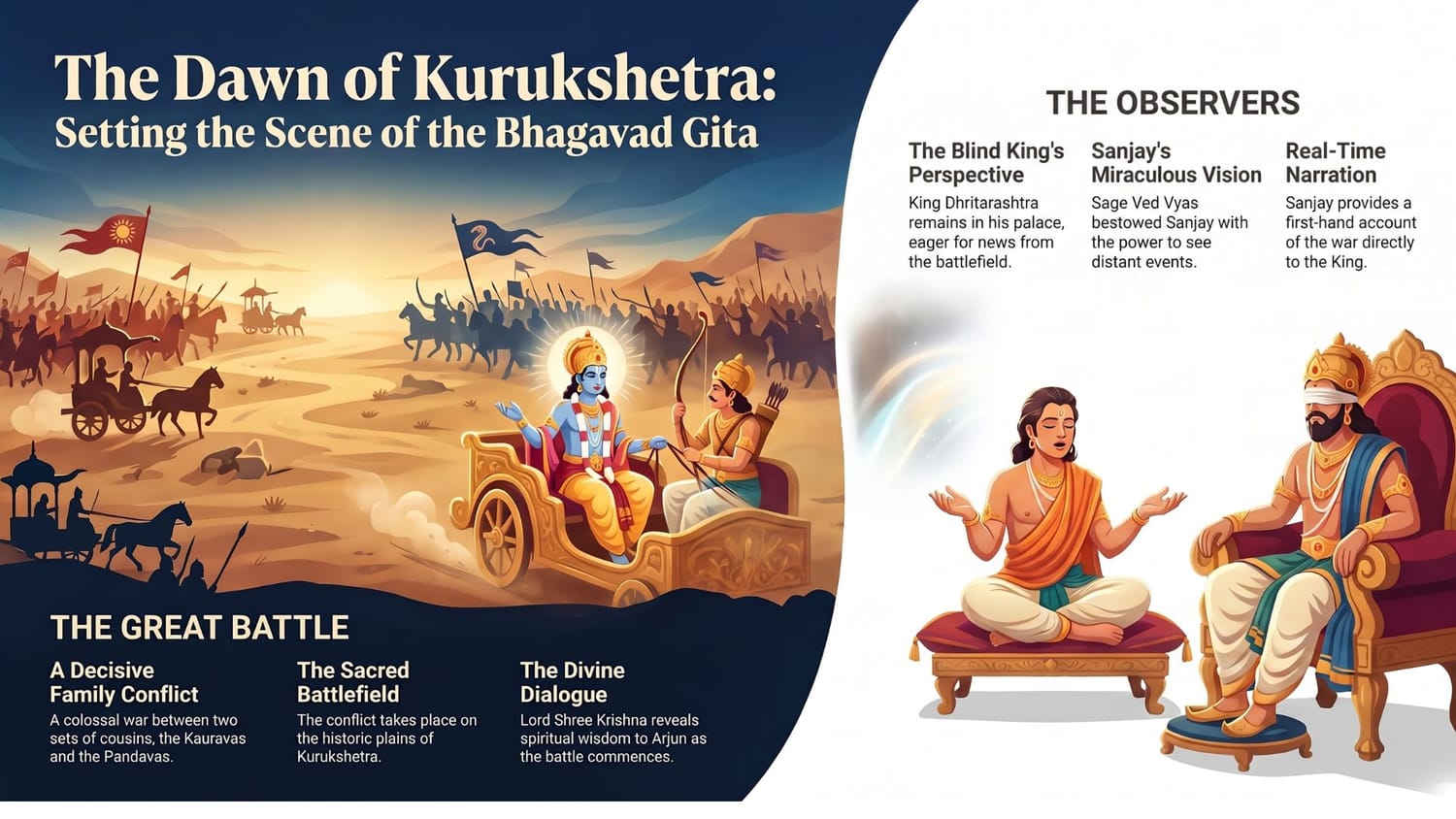
The air at Kurukshetra does not smell of incense or ancient parchment; it reeks of dust, sweat, and the iron tang of impending slaughter. Imagine the harrowing blast of conch shells shattering the silence, the rhythmic thunder of thousand-horse chariots, and the restless shifting of two vast armies. This is the "Divine Livestream"—a colossal war between sets of cousins, the Kauravas and the Pandavas, born from a bitter dispute over a kingdom. It is here, on the razor-thin threshold of a catastrophic conflict, that the Bhagavad Gita emerges. While we often think of this "Song of God" as a serene manual for the soul, its opening chapter reveals that the most profound spiritual truths often arrive not in the hush of a temple, but in the heart of a war zone.
The Surprising Frame Narrative (The Dialogue within a Dialogue)Though the Bhagavad Gita is celebrated as the immortal conversation between Lord Shree Krishna and the warrior Arjun, the text actually pulls its first curtain back miles away from the dust of the battlefield. The narrative begins in the palace of Hastinapur, essentially the "living room" of the ancient world. The first chapter, Arjun Viṣhād Yog , opens with a dialogue between the blind King Dhritarashtra and his minister, Sanjay.There is a haunting irony in this literary frame. Dhritarashtra is physically blind, but his true darkness is internal. His terminal attachment to his own sons, the Kauravas, has blinded him to the moral decay and inevitable destruction his family has invited. He sits in his palace, paralyzed by an agonizing eagerness to know the "on-goings of the battlefield," yet he is the very architect of the tragedy he now watches from afar. By starting with a "blind observer," the Gita suggests a fundamental human tragedy: we are often most blind to the consequences of the fires we ourselves have sparked.
The Original "Remote Viewing" (Sanjay’s Divine Vision)How does a king in a distant palace witness the minute-by-minute reality of a war? The answer lies in an ancient precursor to modern broadcasting. Sanjay was a disciple of Sage Ved Vyas—the author of the Mahabharata —who possessed a "mystic ability to see and hear events occurring in distant places." In an act of divine technology, Vyas bestowed upon Sanjay the "miraculous power of distant vision."This gift turned Sanjay into the world’s first first-hand war correspondent. This "remote viewing" allowed him to bridge the gap between the opulent silence of the palace and the visceral chaos of Kurukshetra. As the source records, "Sanjay could see and hear, what transpired on the battleground of Kurukshetra, and gave a first-hand account to King Dhritarashtra while still being in his palace." Yet, there is a modern weight to this vision; much like our own 24-hour news cycles, Sanjay bears the psychological burden of omniscience—the ability to see everything, yet the power to change nothing.
Wisdom on the Knife's Edge (The Timing of the Revelation)Perhaps the most startling reality of the Gita is its timing. In any other context, the idea of pausing for a philosophical discourse while two armies are "just about to commence" a decisive battle would seem absurd. Usually, one studies the nature of the soul when the belly is full and the mind is quiet. Here, Krishna delivers high philosophy while thousands of men are literally gripping their weapons, their knuckles white with tension.This "wisdom on the knife’s edge" transforms the Song of God into a survival manual. By placing the revelation on the "threshold" of the war, the text argues that spiritual clarity is not a luxury for the retired or the cloistered—it is a desperate necessity for those standing in the crosshairs of a crisis.
The Gita arrives at the precise moment when the "lamenting" of the human heart meets the cold reality of action. It is a reminder that truth is most relevant when the stakes are life and death.The opening of the Gita serves as a bridge into the profound landscape of Arjun Viṣhād Yog , detailing the physical and emotional cost of a war that is both a family feud and a cosmic turning point. As we stand at this narrative threshold, we are forced to look into the mirror of the text.Are we, like King Dhritarashtra, sitting in the palaces of our own making—physically present but spiritually blind to the battles we have helped create? Or are we, like Sanjay, seeking the "distant vision" required to see past the immediate noise of the world to the eternal truth lying beneath? The Gita begins not with a sermon, but with an unsettling question of perspective: what do you see when the storm finally breaks?
Copyright © 2022 SuePats.com - nubeginning.com | All Rights Reserved | PRIVACY POLICY - TERMS & CONDITIONS - DISCLAIMER