

Sue Pats
The Architecture of the Bhagavad Gita's Layered Dialogue
The Architecture of the Bhagavad Gita's Layered Dialogue
The Architecture of the Bhagavad Gita's Layered Dialogue
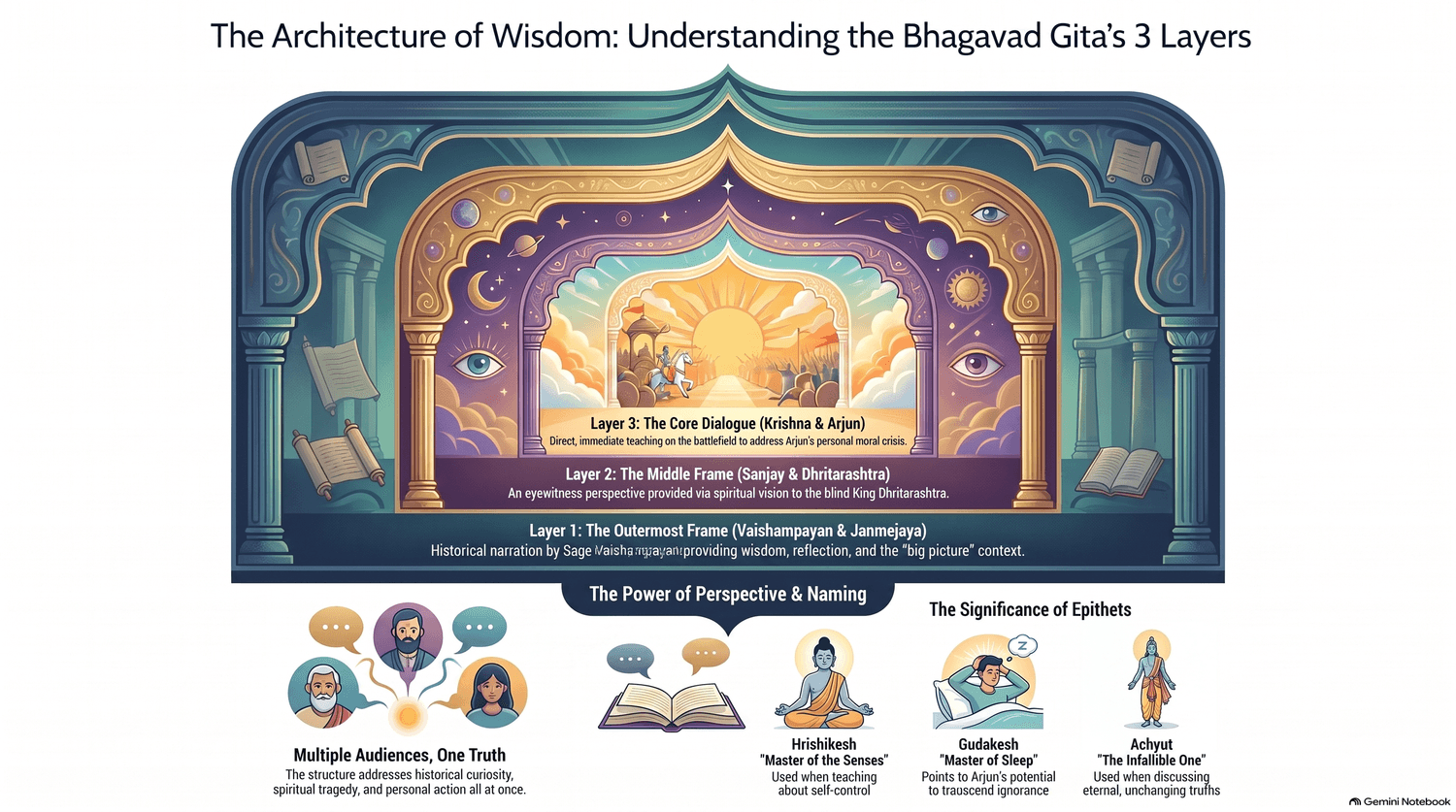
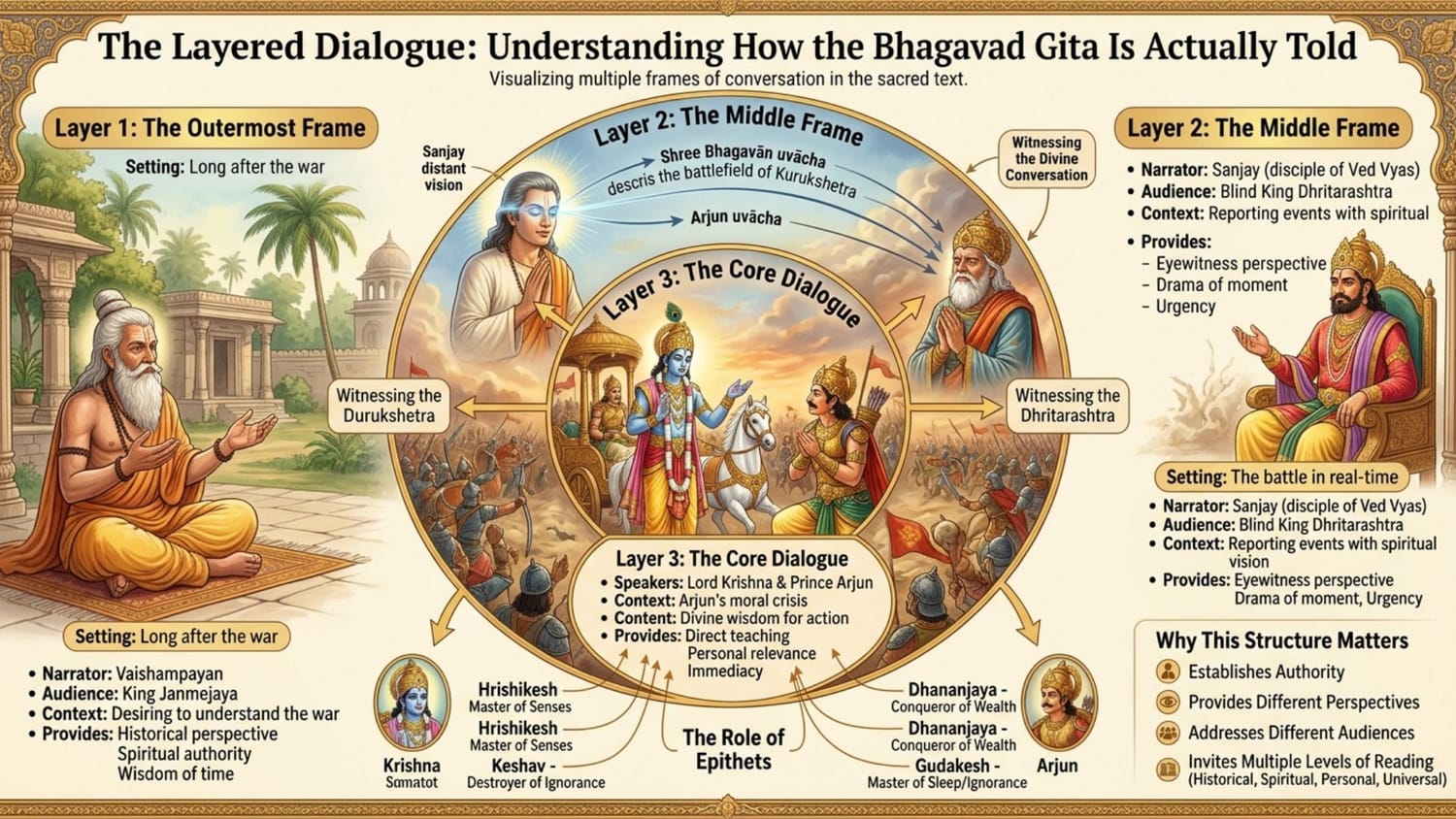
The provided text explores the intricate narrative architecture of the Bhagavad Gita, moving beyond the idea that it is a simple conversation between two people. It reveals that the scripture functions through three distinct layers of dialogue, involving different narrators like the sage Vaishampayan and the visionary Sanjay to establish spiritual authority and historical context. By examining the specific titles and epithets used for Krishna and Arjun, the source illustrates how language highlights particular divine qualities or moral duties. Readers are encouraged to engage with the text on multiple levels, ranging from a historical chronicle to a source of personal transformation. Ultimately, this structural analysis suggests that understanding who is speaking and to whom is essential for grasping the full depth of the Gita’s wisdom. This layered approach transforms the reading experience into a sophisticated spiritual practice that reveals universal truths.
The Layered Dialogue: Understanding How the Bhagavad Gita Is Actually Told
Why the Structure Matters: Multiple Voices, Multiple Layers, One Truth
Most people approach the Bhagavad Gita as if it's a simple dialogue:
Krishna speaks. Arjun listens. Problem solved.
But this understanding misses the profound architecture of the text.
The Gita is actually a conversation within a conversation within a conversation.
And this structure is intentional.
The Three Layers of Dialogue
Layer 1: The Outermost Frame
Sage Vaishampayan narrating to King Janmejaya
The outermost structure:
Setting: Long after the war
Narrator: Vaishampayan, a great sage
Audience: King Janmejaya, who wants to understand the war
What this layer provides:
Historical perspective
Spiritual authority
The wisdom of time
Distance that allows reflection
Vaishampayan isn't just reporting facts.
He's transmitting spiritual wisdom.
His role is to contextualize the teaching.
Layer 2: The Middle Frame
Sanjay recounting the battlefield to King Dhritarashtra
The middle structure:
Setting: The battle itself, in real time
Narrator: Sanjay, disciple of Ved Vyas
Audience: The blind King Dhritarashtra
The gift: Sanjay has "distant vision" and can see everything
What this layer provides:
Eyewitness perspective
The drama of the moment
The urgency and reality of the situation
Sanjay's spiritual gift allowing clear seeing
Why this matters:
Sanjay isn't just describing what happens.
He's presenting what he literally sees through spiritual vision.
He says:
"Shree Bhagavān uvācha" ("The Supreme Lord said")
"Arjun uvācha" ("Arjun said")
He's witnessing the divine conversation unfold.
Layer 3: The Core Dialogue
Krishna speaking directly to Arjun
The core structure:
Setting: On the battlefield, between armies
Speakers: Lord Krishna and Prince Arjun
Context: Arjun's crisis of conscience
Content: Divine wisdom for the situation
What this layer provides:
Direct teaching
Personal relevance
Immediacy and urgency
The application of wisdom to real life
Why This Structure Exists
It's Not Accidental
This three-layer structure serves purposes:
1. It Establishes Authority
Multiple levels of transmission:
From Krishna (divine)
Through Sanjay (spiritual visionary)
Through Vaishampayan (great sage)
To you (the reader)
The teaching comes through reliable channels.
2. It Provides Different Perspectives
Vaishampayan's perspective:
Wisdom of reflection
Understanding time
The big picture
Sanjay's perspective:
Direct seeing
Spiritual vision
What's actually happening
Krishna's perspective:
Divine truth
Universal teaching
The eternal principle
You get all three.
3. It Addresses Different Audiences
Janmejaya (the historical king):
Wants to understand the war
Wants historical knowledge
Wants to learn from what happened
Dhritarashtra (the blind king):
Can't see what's happening
Wants to understand his sons' fate
Wants spiritual guidance on tragedy
Arjun (the present warrior):
Needs immediate guidance
Faces a moral crisis
Needs to act now
All three are addressed simultaneously.
4. It Invites Multiple Levels of Reading
You can read the Gita:
As history (through Vaishampayan)
As spiritual seeing (through Sanjay)
As direct teaching (through Krishna)
As personal guidance (applied to your life)
The Role of Epithets
Notice that Krishna and Arjun have many names:
Krishna's Names
Hrishikesh - "Master of the senses"
Used when teaching about sense control
Points to Krishna's mastery over all senses
Keshav - "He who destroys ignorance"
Used when teaching wisdom
Points to Krishna as the remover of delusion
Govind - "Protector of cows/nature"
Used when speaking of care and duty
Points to Krishna's nurturing aspect
Madhusudan - "Destroyer of the demon Madhu"
Used when speaking of destroying obstacles
Points to Krishna's power over obstacles
Achyut - "The infallible one"
Used in contexts of eternal truth
Points to Krishna's unchanging nature
Arjun's Names
Dhananjaya - "Conqueror of wealth"
Points to his material success
But ironically, in contexts of renunciation
Gudakesh - "Master of sleep/ignorance"
Points to his potential to transcend delusion
Kaunteya - "Son of Kunti"
Reminds him of his lineage
Connects him to his divine heritage
Parantapa - "Scorcher of the enemy"
Reminds him of his warrior nature
Used in contexts where he needs strength
Why This Matters
Each epithet carries meaning.
Each time an epithet is used, it:
Emphasizes a quality
Reminds of a principle
Sets the tone
Applies the teaching
The reader who notices the epithets sees the teaching more deeply.
How to Read With the Structure in Mind
Level 1: Historical Reading
Read it as:
A record of the Mahabharata war
What happened and why
The context and characters
The narrative arc
Level 2: Spiritual Reading
Read it as:
Sanjay's spiritual vision
What's really happening beyond the surface
The divine acting through events
The deeper reality
Level 3: Personal Reading
Read it as:
Krishna speaking to you
Your crisis, your dharma, your growth
Direct guidance for your life
Your own transformation
Level 4: Universal Reading
Read it as:
Timeless teaching
Universal principles
Applicable to all times and places
Eternal wisdom
All four levels are valid.
The text rewards reading on all levels.
This Week's Reflection
Question 1: How Are You Currently Reading?
Are you reading:
For historical understanding?
For spiritual inspiration?
For personal guidance?
For universal principles?
Which level are you on?
Question 2: Can You Hear Multiple Voices?
Can you distinguish:
Vaishampayan's voice (the narrator)
Sanjay's voice (the witness)
Krishna's voice (the teacher)
Arjun's voice (the questioner)?
Can you hear them all?
Question 3: What Do the Epithets Tell You?
Notice the next epithet used:
What does it emphasize?
Why that quality at that moment?
What's being highlighted?
What does it teach?
Question 4: How Do Layers Deepen Understanding?
When you see the full structure:
Does it feel more significant?
Does it feel more trustworthy?
Does it deepen the teaching?
Does meaning multiply?
Question 5: How Will You Read Going Forward?
Will you:
Notice the structure intentionally?
Track the different voices?
Observe the epithets?
Read on multiple levels?
The Practice: Reading With Awareness
Week 1: Identify the Speakers
As you read:
Notice when Vaishampayan speaks
Notice when Sanjay narrates
Notice when Krishna teaches
Notice when Arjun questions
Track the different voices.
Week 2: Notice the Epithets
As you read:
Highlight each epithet
Note which is used
Understand what it emphasizes
See the pattern
Build awareness of naming.
Week 3: Ask: Who Is Speaking?
For each passage, ask:
Who is the audience?
What is the context?
Why this teaching now?
What perspective does this represent?
Read with full awareness.
Week 4: Read on Multiple Levels
For a passage you love:
Read it as history
Read it as spiritual seeing
Read it as personal guidance
Read it as universal principle
Experience the layers.
Week 5-Ongoing: Develop Sophisticated Reading
Over time:
Your reading becomes richer
You see multiple levels simultaneously
Meaning deepens
The text reveals itself fully
You understand the structure is the wisdom
The Promise
When you read the Gita with awareness of its structure:
You understand it's not a simple dialogue
You see multiple perspectives simultaneously
You hear divine wisdom speaking through human voices
You connect with layers of tradition
Your understanding deepens
You truly comprehend the text
Notice the structure. Track the voices. Observe the epithets. Read on multiple levels. Understand the full teaching.
#BhagavadGita #Structure #MultipleVoices #LayeredWisdom #SacredText #EpithetsAndMeaning #DepthOfTeaching
Copyright © 2022 SuePats.com - nubeginning.com | All Rights Reserved | PRIVACY POLICY - TERMS & CONDITIONS - DISCLAIMER