

Sue Pats
The Architecture of Collapse: Why Removing Guidance Destroys Everything
The Architecture of Collapse
Blog Post: BG 1.41 - The Architecture of Collapse: Why Removing Guidance Destroys Everything
"With the Preponderance of Vice, the Women of the Family Become Immoral; and From the Immorality of Women, Unwanted Progeny Are Born"
This verse is often misread.
It seems to be about women's morality.
But it's actually about what happens when the structures that guide people disappear.
What This Verse Really Says
Let's decode it carefully:
"With the preponderance of vice"
When irreligion (disconnection from values) spreads through the system.
"The women of the family become immoral"
The people who are responsible for transmitting values (in this context, women) lose their ability to do so, because they themselves have no guidance.
"From the immorality of women, unwanted progeny are born"
When the transmitters of values are themselves lost, the next generation is born without moral foundation.
In modern language:
When your organization loses its values and guidance structures, the people responsible for culture are left stranded.
They can't transmit what they don't have.
And the next generation is born into chaos.
The Structure That Holds Civilization Together
Arjuna is recognizing something fundamental:
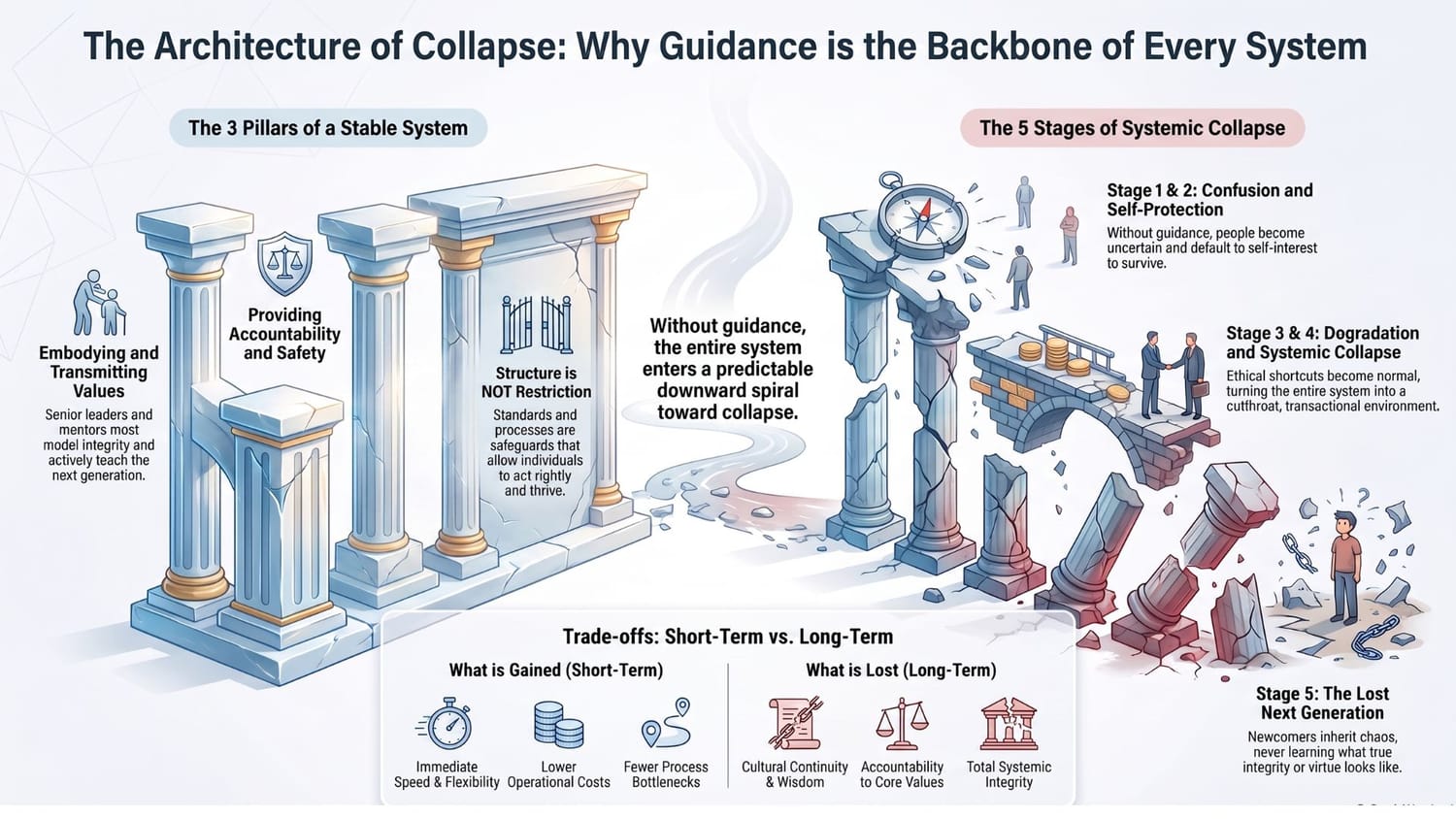
Civilization is held together by guidance and structure.
Not by individual goodness. But by systems that help people act rightly.
When those systems collapse:
People don't suddenly become saints who act right on their own
They become lost
They default to self-interest
They do whatever they need to survive
The whole system unravels
The Role of Guidance and Structure
In any system (family, organization, society), there are people and structures that:
Role 1: Embody Values
Some people carry and live out the values of the system.
In a family: elders who show what virtue looks like.
In an organization: senior leaders who model integrity.
When these people are gone, values become abstract. No one shows what they actually look like.
Role 2: Provide Accountability
Some structures hold people accountable to values.
In a family: traditions, rituals, communal judgment.
In an organization: processes, systems, peer accountability.
When these structures are gone, people aren't accountable to anything but themselves.
Role 3: Transmit Wisdom
Some people teach the next generation.
In a family: parents, grandparents, aunts, uncles.
In an organization: mentors, senior leaders, long-time employees.
When these people are gone, the next generation has no guidance.
Role 4: Provide Safety
Some structures protect people while they learn and grow.
In a family: the family structure itself provides safety.
In an organization: clear expectations, mentorship, gradual responsibility.
When these structures disappear, people aren't safe. They're exposed.
What Happens When These Collapse
When you remove the people and structures that provide guidance:
Stage 1: Confusion
People don't know what's expected. They're uncertain what's right.
Stage 2: Self-Protection
Without guidance, people default to protecting themselves.
They do what they need to do to survive.
Stage 3: Degradation
As more people default to self-interest, values degrade.
What seemed impossible (cutting corners, breaking ethics) becomes normal.
Stage 4: Systemic Collapse
When enough people are acting from self-interest, the whole system becomes transactional.
No one does anything for the right reasons.
Everyone does it for themselves.
Stage 5: Lost Next Generation
The people born into this system have no model of virtue.
No one teaches them what's right.
They think this (self-interest, chaos, moral confusion) is how the world is.
The Business Equivalent: When Guidance Structures Collapse
The Company That Eliminates Mentors
What happens: A company decides mentorship programs are inefficient. Senior people spend too much time training.
They eliminate mentors to maximize productivity.
Stage 1: Junior people are confused. They don't know how to do things right.
Stage 2: Junior people figure out how to survive. They copy what works, regardless of whether it's ethical.
Stage 3: Unethical shortcuts become normal because no one taught the right way.
Stage 4: The culture becomes cutthroat. Everyone is for themselves.
Stage 5: The company loses its best young people. And the next generation of leaders are people who never learned integrity.
The Organization That Eliminates Processes
What happens: An organization decides processes are bureaucratic. They eliminate approval systems, reviews, and checks.
They want speed and empowerment.
Stage 1: People are confused about what's acceptable.
Stage 2: People make decisions to protect themselves and hit targets.
Stage 3: Shortcuts and corner-cutting become normal.
Stage 4: Ethics collapse. People do whatever gets results.
Stage 5: The organization loses integrity. And new people never learn what integrity looks like.
The Team That Eliminates Standards
What happens: A team decides standards are constraining. They eliminate code reviews, quality checks, documentation.
They want agility and autonomy.
Stage 1: People are unsure what quality means.
Stage 2: People focus on shipping, regardless of quality.
Stage 3: Low quality becomes normal.
Stage 4: People stop caring about quality. It's all about speed.
Stage 5: The team burns out. Quality collapses. And new people never learn what good looks like.
The Specific Insight About Women (And What It Really Means)
The verse specifically mentions women because in that culture, women were responsible for transmitting values in the home.
The point is NOT that women are weaker or more likely to be immoral.
The point is: When the people responsible for transmitting values are themselves left without guidance, the system collapses.
In modern terms, this applies to anyone responsible for transmitting culture:
Managers who mentor
Senior leaders who model values
Team leads who teach
Founders who embody mission
When you remove these people without replacing them, the next generation has no guidance.
And the system collapses.
Why Organizations Remove These Structures
If guidance structures are so crucial, why do organizations remove them?
Reason 1: They Look Inefficient
Mentorship takes time. It doesn't produce immediate output.
So efficiency-focused organizations eliminate it.
Reason 2: They Slow Things Down
Processes and accountability slow decisions.
So speed-obsessed organizations eliminate them.
Reason 3: They're Expensive
Senior people cost more than junior people.
So cost-focused organizations eliminate them.
Reason 4: They Seem Unnecessary
If people are "good," they don't need guidance, right?
So some organizations assume guidance isn't necessary.
But this is short-term thinking.
The Hidden Cost of Removing Structure
When you remove guidance structures, you might gain:
Immediate speed
Lower costs
Flexibility
Fewer bottlenecks
But you lose:
Guidance for the next generation
Accountability to values
Transmission of wisdom
Cultural continuity
Systemic integrity
And the cost far exceeds the gain.
The Practice: Protecting Your Guidance Structures
If you want to maintain a culture that lasts, practice this:
Practice 1: Identify Your Guidance Carriers
Who in your organization is responsible for transmitting values?
Mentors?
Senior leaders?
Long-time employees?
People who embody your culture?
Protect them.
Practice 2: Institutionalize Guidance
Don't just rely on individuals.
Create systems:
Mentorship programs
Onboarding that transmits values
Regular teaching and training
Documented practices
Clear expectations
Practice 3: Value the Structures
Don't see accountability structures as constraints.
See them as what allows people to act rightly.
Code reviews aren't restrictions; they're safeguards
Processes aren't bureaucracy; they're guidance
Standards aren't limiting; they're liberating
Practice 4: Invest in the Next Generation
Don't just promote people. Develop them.
Don't just hire people. Guide them.
Don't just assign work. Teach them.
The next generation's integrity depends on your guidance.
What Arjuna Is Understanding
Arjuna is understanding something crucial:
You cannot have a moral system without structure and guidance.
Individual goodness isn't enough.
You need:
People who model virtue
Structures that hold people accountable
Systems that transmit wisdom
Culture that guides behavior
When you destroy these, you don't liberate people.
You leave them lost.
This Week's Reflection
For your organization:
Question 1: Who Carries Your Guidance?
Who is responsible for transmitting your values?
Who teaches the next generation?
Who models integrity?
Are they protected or vulnerable?
Question 2: What Structures Support Your Culture?
What processes ensure people act according to your values?
What systems transmit wisdom?
What accountability exists?
Are these structures being maintained or eroded?
Question 3: What Would Happen If They Were Removed?
If you removed your mentors, who would guide the next generation?
If you eliminated your processes, what would replace them?
If you removed your accountability structures, what would happen to culture?
Be honest about the answer.
Question 4: How Are You Investing in Guidance?
Are you protecting the people who carry culture?
Are you maintaining the structures?
Are you investing in transmitting wisdom?
Or are you gradually eroding these?
The Promise
When you maintain guidance structures and protect the people who carry them:
The next generation has models to follow
Values endure
Culture strengthens
People know what's right
The organization maintains integrity through generations
Arjuna's insight in Verse 41 is about something fundamental:
Systems that hold people accountable to values aren't restrictions.
They're what allows humans to act rightly.
When you remove them, you don't liberate people.
You leave them lost.
#Leadership #Culture #Guidance #Structure #Systems #BhagavadGita #SmallBusiness #OrganizationalHealth
Coming Next:
Chapter 1, Verses 42-47 & Chapter 2, Verses 1-11: "The Final Crisis and Complete Surrender"
Now that Arjuna has articulated the complete scope of destruction—personal, relational, moral, systemic, generational, and cultural—he's going to reach absolute breakdown.
He's going to lay down his weapons.
He's going to admit complete defeat.
He's going to surrender to Krishna completely.
And in that moment of complete surrender—when he has no answers, no certainty, no way forward—Krishna's teaching begins.
The Bhagavad Gita proper starts when Arjuna admits he cannot know the answer.
And asks Krishna to show him the way.
Copyright © 2022 SuePats.com - nubeginning.com | All Rights Reserved | PRIVACY POLICY - TERMS & CONDITIONS - DISCLAIMER